Publication Date: September 2024
Publisher: National Trust Books
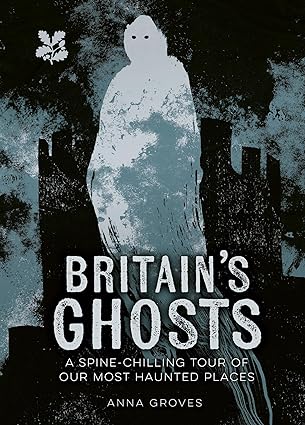
Having previously read ‘Chasing the Dark’ by Ben Machell early last month, it would seem I am enjoying books on all things supernatural. Anna Groves’ book ‘Britain’s Ghosts: A spine-chilling tour of our most haunted places’ is a perfect dip in and dip out dictionary for supernatural settings. Geared around National Trust locations it is a perfect accompaniment to these already evocative places.
Groves sets out to explore “inexplicable events that have raised the hairs of that unfortunate enough to experience something for which they’ll be consoled by few and disbelieved by many.” It is unclear whether or not Groves is, in the words of Danny Robins a ‘team believer’ or ‘team sceptic’ however she does state that the locations in the book are “where the dramas of human lives have played out, just out of sight, just beyond all our earthbound senses.” The very idea of the supernatural raises more questions than can be answered. Why do some people have experiences and others none? Why only some places and not others? Why have we not been able to prove anything beyond all reasonable doubt? What is clear is that humans are drawn to it have and have been for thousands of years. Unfortunately, we are told that “if you’re looking for answers, you won’t find them here.”
It is our “continuing fascination with the psychology of the paranormal rather than a widespread belief in the existence” that keeps people hunting for more. And so we begin our tour from Buckland Abbey in Devon which is well populated with ghosts but by far the most famous is “Sir Francis Drake. Renowned seaman of the Elizabethan Age and a favourite of Elizabeth I.” A particularly compelling setting is Lydford Gorge in Devon where you might explore the White Lady Waterfall, the tallest in South Wales where a ghost is said to haunt the base.
Another interesting location would be Glastonbury, said to be the “occult capital of England” where there lives a chuckling monk, quite the opposite of what we might expect from our more stereotypical spectres. Perhaps a bit spookier is the Ancient Ram Inn in Gloucestershire, originating from around the 12th Century its oldness makes it a contender for the most haunted place in Britain with up to 20 (!) ghosts who inhabit it. Then of course is the Tower of London which interestingly only had ten people executed within its walls, the most famous being Anne Bolelyn whose screams can be heard along with the cries of the nephews of the Richard III, the Duke of Gloucester. Anne’s ghost is busy and is said to haunt Hampton Court too making her, according to Groves the “most well-travelled of Britain’s ghosts” she lingers perhaps as a recognition and a left-over shock from how brutal, swift and horrifying her fall from grace was.
Onto Derbyshire and High Peak Estate where we are told the story of Clara who in 1758 eloped with an unsuitable man who possibly goes by the name of Alan. On route they were attacked at Winnats Pass and buried by a group of suspected hoodlums. They were not discovered for many years and their screams can still be heard reminding people of their terrible fate. We also have Newstead Abbey where Byron’s dog prowls looking for him. Or Lyveden in Northamptonshire where there is a spectre near an unmarked grave or Norfolk’s Raynham Hall said to be inhabited by a so called brown lady.
Very often these places are old and have a rich history or tapestry of narratives and voices attached to them with the whole spectrum of human emotions having been experienced within their walls. We cannot fail to want to think about what might be and what still is, hopeful that something else exists beyond this earthly realm. However if this is all too much, and the idea of ghost and ghouls haunting these places is something you cannot abide, the National Trust do some fantastic walks and creams teas.
 Currently Reading