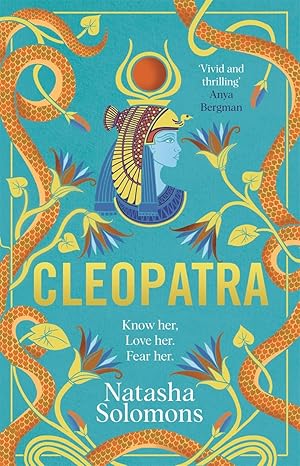
Publication Day: May 2025
Publisher: Manilla Press
As someone who was not familiar with the story of Cleopatra, I went into this book expecting to learn lots of interesting facts about her life and her rule as monarch. The book switches between Cleopatra’s first-person perspective and that of Servilla, an older female who for many years has been Caesar’s mistress. We begin with Cleopatra as a young child, raised alongside Charmain, a slave, but also her closest companion and confidant. As readers, we are signposted to the significance of this relationship and the class dynamics that underpin their interactions. I felt even though this was a significant relationship within the novel, it would have been interesting to explore the intricacies of this further as Charmain was a trusted advisor to Cleopatra and an interesting historical character in her own right.
Natasha Solomon highlights the academic and discerning ability of her central protagonist to understand the power struggles within her kingdom after her father’s death. Ptolemy, Cleopatra’s brother, means to take the leadership role for himself despite the decree they should rule together. It is up to Cleopatra to use her wit and intelligence to both stay alive and navigate the changing political climate that is engulfing her. I have read criticism over the representation of Ptolemy in terms of his physical girth and grotesqueness, he is painted as a stereotypical villain however my experience of reading this was more the fact that he was motivated by his dislike of a female being more capable and apt for the role of a leader unlike his petulant self who was most certainly less intelligent and able at ruling. This seemed to fit with the attitudes at the time and for many of the individuals within the text.
Cleopatra’s interaction with Caesar was also a point of interest. Once he becomes part of the narrative, he tends to dominate but in a way that I felt created tension for us as readers as it added a level of unpredictability which made the reading experience more compelling. Cleopatra’s leadership and by extension her life, is in the hands of this man who could turn at any given moment. As readers we hope she can manoeuvre the politics and power dynamics effectively to her will and get the outcomes she deserves. As someone who knows very little about the life and rule of Cleopatra this reading experience has motivated me to seek out biographies and histories written about her, which seems a good as recommendation as any to read a copy of this book!
Thank you to Netgalley for my ARC
 Currently Reading