Publication Date: 12th March 2026
Publisher: Bloomsbury
One of the best things about finding new to me writers is the anticipatory joy of exploring their back catalogue. Sally Coulthard, a small holder and nature writer has an extensive back catalogue with books entitled, ‘Fowl Play: The History of the Chicken’, ‘The Little Book of Snow’ and ‘The Hedgehog Handbook’ I feel very fortunate at what I have to look forward to! In her latest book, Sally Coulthard is asking us to stop and consider the wonderous event of twilight and find the magic that is right before our eyes.
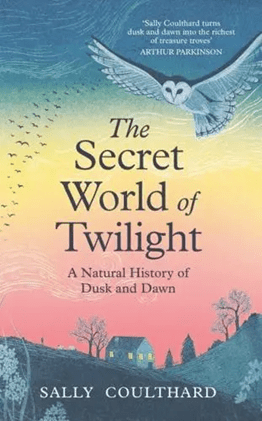
We are told that ‘Everyday in the period of time just before sunrise and straight after sunset, magic happens’ twilight is the dawn in the morning and the dusk of the evenings. The uniqueness of our planet in having twilight creates a special set of events and circumstances which we can be privy to if we take notice. From the very beginning of ‘The Secret World of Twilight: A Natural History of Dusk and Dawn’ I was hooked. The book is filled with an array of fascinating details and scientific facts but it is presented in a way that is so accessible that it felt like having a chat with a really knowledgeable friend.
Within the book there is an exploration of the science, history, literature and vocabulary connected to the idea of twilight, this special liminal time where the world changes tempo, a slowing down or a pause. For us it may feel like this however twilight creatures, or creatures that are more active during this period, known as ‘crepuscular’ and for them it is a busy and productive time. We learn that ‘the word ‘crepuscular’ comes from the Latin for twilight ‘crepusculum’ a word that probably emerged from creperus meaning ‘obscure.’ A blurring of both vision and time. Coulthard highlights the idea that we are losing the capacity for wonder in a world that seeks to pull and hold our attention in different ways, noting the loss of vocabulary that describes the world of twilight, a world that our ancestors would have been extremely familiar with as a form of necessity and survival but also potentially as sacred. We are told that even in the countryside, we are ‘immune to the effects of light pollution and the modern world’s insistence of being permanently lit.’ Today’s society has changed its relationship with the dark however ‘we need to hold on the magic of twilight too’ and that it ‘has never felt so urgent.’
It is hard not to write down all the different things that I learned whilst reading the book however, one of the most important felt the different stages of twilight which cause a gradual loss and return to light: civil twilight, nautical twilight and astronomical twilight and how this is felt and experienced across different lands. Many years ago, these different stages would have sign posted the end of a working day was imminent, or enabled sailors to utilise the night sky as navigation. Today it feels we have rushed and compressed our time to night and day and lifted out that transitional time. This is not only impactful on our health and circadian rhythms, apparently this is the time of highest birth rates amongst humans and animals. It also a time that sees mass animal migrations however these are being impacted by our constantly bright and noisy world. It seems that we are supposed to experience twilight gradually with the earth’s rhythm and movements and we should be mindful of what is being lost. There was also the beautiful idea of the terminator line, ‘twilight viewed from the stars’ and the lux, a light measurement that again filled me with wonder and awe.
To be awed by the concept of twilight is nothing new, it has been featuring in our literature as a place of beauty but also a place of danger or mystery, an ominous foreshadowing. As Sally Coulthard highlights many mythical creatures and folk tales have this time as their backdrop, creatures like the Phooka, who supposedly misguides travelers leading them astray and various werewolves and vampires who are motivated by the shadows. From the reading of the book it is clear that twilight invites us to see in different ways, to experience in different ways, to be in different ways. A wonderful book that needs revisiting time and time again.
 Currently Reading